주요안내


메인메뉴


Inquiry- and discussion-based classes aligned with IB education.
Developed and operates an “Extracurricular Portfolio System."
Creative experiential and club activities, with a strong focus on character education.
IB graduates admitted to universities in 11 countries worldwide.
Last year, 22 students were accepted to top universities ranked within the global Top 50.
Visiting the education field in 2025: Gyeonggi Academy of Foreign Languages (GAFL).
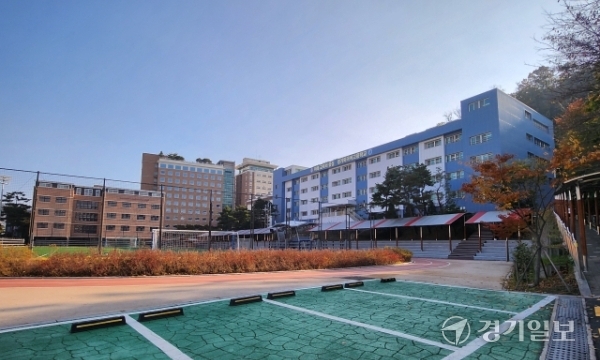
An exterior view of GAFL. Photo by Reporter Park Hwa-seon.
Gyeonggi Academy of Foreign Languages (GAFL) is a private special-purpose high school located in Gocheon-dong, Uiwang City. Founded in 2004, the school aims to nurture creative global leaders who serve the international community. In 2011, GAFL became the first high school in Korea to introduce the International Baccalaureate Diploma Programme (IBDP), and it is now widely recognized as a leading hub for IB education in Gyeonggi Province and nationwide.
Operated by the Bongam Educational Foundation, GAFL transitioned in late October to a new leadership structure led by Honorary Chairman Kang Young-joong and Chairman Kang Ho-joon. In response, the school established its mid- to long-term development plan, “VISION2028,” and is promoting nine key strategic initiatives centered on two core directions: “Academic Excellence” and “Going Global.” These initiatives include building an innovative future-oriented education system, advancing student competency-based growth support, strengthening an IB-focused global creative convergence curriculum, and enhancing an environment that allows teachers to immerse themselves in high-quality instruction.
International-Standard IB Education: Students Expand Opportunities with Admissions to Universities in 11 Countries Worldwide
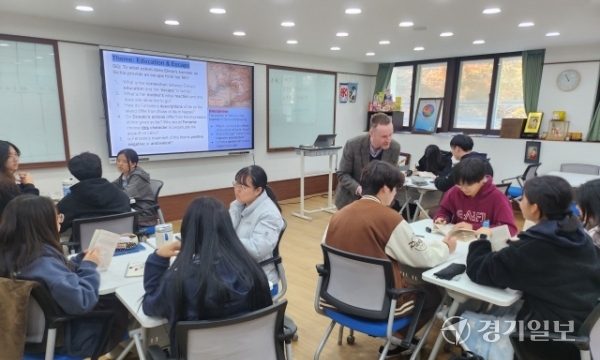
A GAFL IB English class led by a native-speaking teacher. Photo by Reporter Park Hwa-seon.
GAFL is organized into several departments, including the English Department (Korean track and IB International track), the Chinese Department, and the Japanese Department. In particular, the IB curriculum, designed for students aiming to enter overseas universities, supports them in becoming well-balanced learners who connect knowledge and inquiry, thinking and reflection, as well as local and global perspectives.
With an internationally rigorous assessment system, GAFL moves beyond uniform, rote memorization and delivers inquiry- and discussion-based classes grounded in conceptual understanding. Through this approach, the school fosters academic excellence while also developing students’ character, collaboration skills, and ethical awareness in an integrated way.
The IB aims to cultivate critical thinking, intellectual curiosity, international-mindedness, and balanced personal development. By earning the IB Diploma, students can use it to support university applications to more than 4,500 institutions across 11 countries worldwide.
To support teachers, GAFL also hosts educational forums on practical IB implementation, professional training sessions, open classes, and conferences, providing meaningful training opportunities and sharing expertise with institutions and educators interested in IB education.
Broad Pathways for University Admissions and Career Planning: GAFL’s Distinctive Approach to Education
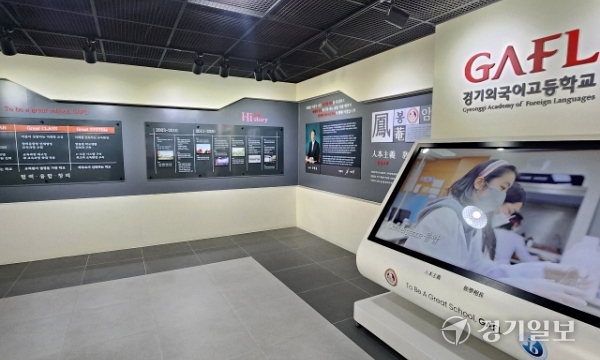
The lobby showcasing the history of GAFL. Photo by Reporter Park Hwa-seon.
GAFL’s national curriculum is based on Korea’s high school credit system and follows the requirement for foreign language high schools to complete at least 68 credits in specialized courses within the foreign language and international studies tracks. In addition, GAFL applies its own distinctive curriculum structure.
First, the school requires students to complete 12 credits in international studies specialized courses to better support those aiming to pursue social science-related fields. It also offers Calculus II, a required subject for science-track students and a useful course for those preparing for business and economics-related majors.
In response to the growing demand for AI-related career competencies, GAFL provides information technology courses ranging from a minimum of two to a maximum of five subjects, helping students build essential foundations.
Unlike many foreign language high schools, GAFL allocates four credits each to CSAT-related subjects such as Korean language, mathematics, social studies, and science. This approach is designed to help students plan broader university pathways and career goals without being limited to a single academic track such as humanities, social sciences, or business.
GAFL also reflects IB’s inquiry- and discussion-based teaching methods and its learner-centered educational philosophy within the national curriculum. Rather than focusing solely on content delivery, the school offers project-based and inquiry-based learning that encourages students to identify problems independently and explore solutions, strengthening both critical thinking and communication skills.
Beyond academic achievement in each subject, GAFL places importance on documenting individual student growth and reflection. It has also developed and operates an “Extracurricular Portfolio System” that reflects the spirit of CAS (Creativity, Action, Service), one of the core components of the IB programme.
Admissions to Top Universities in Korea and Abroad: Active Creative Experience and Club Activities
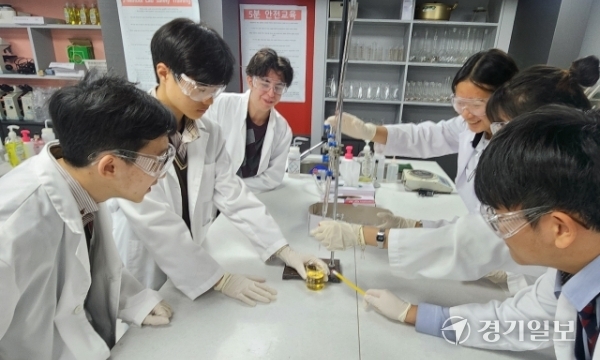
A GAFL IB Science class led by a native-speaking teacher. Photo by Reporter Park Hwa-seon.
Last year, GAFL reaffirmed its reputation as a prestigious private school, with 132 students admitted to leading Korean universities such as Seoul National University, Yonsei University, Korea University, Sungkyunkwan University, and Sogang University, along with approximately 30 students entering renowned universities overseas.
IB graduates from GAFL have gone on to universities across 11 countries—including the UK, the US, Singapore, Australia, Canada, China, Japan, the Netherlands, and Germany—attending a total of 149 institutions worldwide. Among last year’s 32 IB graduates, 22 students were accepted to top-ranked universities within the global Top 50.
The school provides individualized career and university admissions guidance through two professional college counselors, each with more than 20 years of experience. GAFL also runs country- and university-specific personal statement writing and interview preparation programs for students and parents.
In addition, the school offers a wide range of opportunities for students to explore career interests through creative experiential activities and club programs. During self-directed activity periods, students voluntarily engage in reading, team projects, and independent research. To help students grow into capable individuals with both strong character and a sense of community, GAFL holds character education sessions during Assembly time, when all students gather in the auditorium.
GAFL offers around 40 main clubs covering areas such as journalism, social issues, psychology, business, economics, culture, education, science, international exchange, and human rights. In addition, students independently operate more than 50 self-organized clubs.
Interview Zoom-In
Principal Yuk Kwang-hee: “Distinctive Education… Leading Education Trends”

Principal Yuk Kwang-hee
“The biggest strength starts with our distinctive IB curriculum. In a sense, we have dramatically led education trends in Korea.”
Principal Yuk Kwang-hee responded this way when asked about GAFL’s key advantages, adding that “due to strong demand for the IB track, we have organized two IB classes per grade starting this year.”
He continued, “Since sports or arts are required in the first year, students begin with the idea of ‘one student, one specialty,’ and they can continue in the second year as well if they wish.” He added, “There are countless strengths, including a high-level curriculum, flexible study time supported by dormitory life, extensive reading programs, student-led learning, and supervised self-study rooms.”
After taking office in March 2023, Principal Yuk also changed the school’s entrance ceremony schedule. Traditionally held on a Monday, the ceremony was moved to Sunday evening when students move into the dormitory, allowing regular classes to begin immediately on Monday. Parents responded very positively.
Starting this year, GAFL launched an exchange program with Kyoto Kokusai Junior and Senior High School in Japan. He noted, “In March, students from Kyoto Kokusai stayed at our school for eight nights and nine days, joining classes and activities together.” He added, “In January next year, we plan to continue mutual cultural exchange and academic collaboration in Japan.” He also said the school plans to expand exchange programs further into Chinese-speaking and English-speaking regions.
Beginning with the 2027 academic year, GAFL also plans to admit international students outside the standard admissions process. Principal Yuk explained that this is “a strategic move aligned with the global era,” and stated that “students will strengthen their communication skills, reduce cultural bias, and develop a more open and democratic mindset.”
Reporter Park Hwa-seon (hspark@kyeonggi.com)

COPYRIGHT BY GYEONGGI ACADEMY OF FOREIGN LANGUAGES. ALL RIGHTS RESERVED.